
Elections in Brazil: Lula pulls off a historic comeback but will face a more challenging Congress
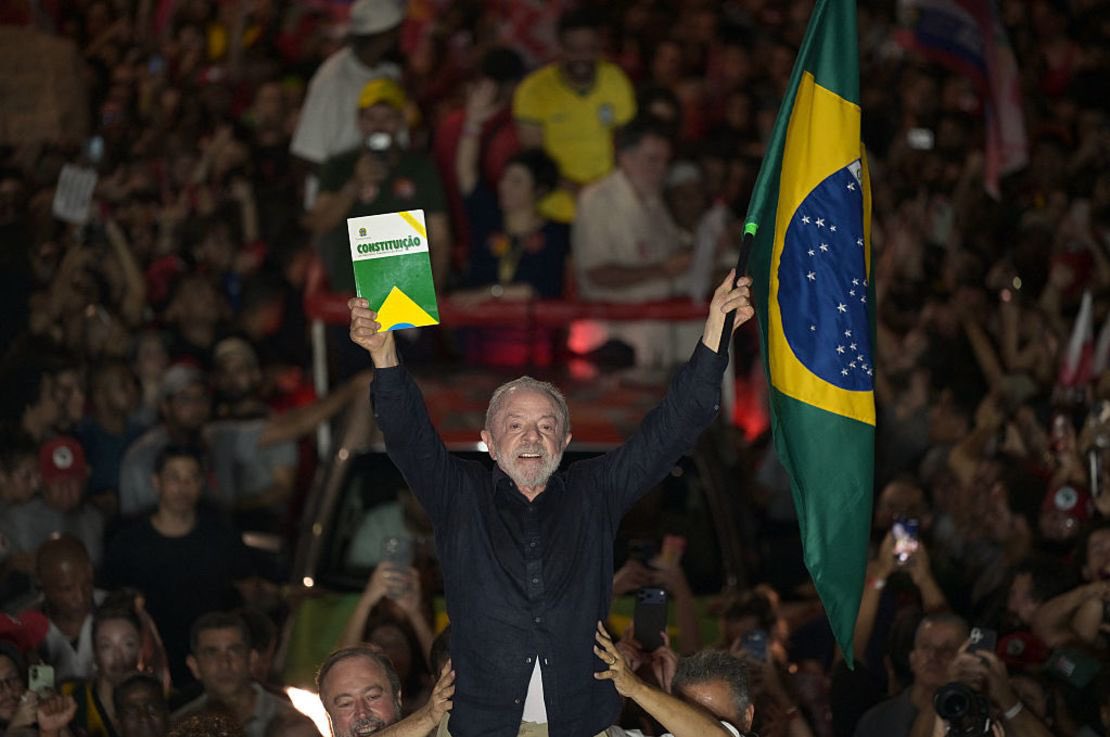
Lula da Silva (PT) was re-elected president of Brazil in the runoff held on Sunday, October 25. He won 51.79% of the valid votes (64.2 million), compared with 48.21% for Flávio Bolsonaro (PL) (59.8 million), a margin of 4.4 million votes. Lula thus became the first candidate to overturn a first-round defeat in a runoff and the first president to win the office four times. He will begin his fourth term on January 5, 2027.
Lula went from trailing Flávio by 2.2 million votes in the first round to winning the runoff by 4.4 million. His comeback was driven mainly by higher turnout: abstention fell from 21.08% to 19.21%, bringing 2.83 million additional voters to the polls, while blank and null votes dropped from 4.8% to 3.2%. To a lesser extent, the president also benefited from the voters of eliminated candidates, who gave him a net advantage of 600,000 votes. He increased his vote count in every state and in the Federal District. The shift was especially significant in Minas Gerais, the only state where he flipped the result and which once again proved to be a bellwether for the national outcome.
Flávio Bolsonaro refuses to accept the result
Flávio Bolsonaro announced that he will not recognize Lula’s victory. He questioned the Supreme Federal Court’s (STF) decision to extend voting by two hours, until 7 p.m., even though both campaigns had requested the extension after problems with public transportation. According to the Superior Electoral Court (TSE), only 35,521 votes were cast after 5 p.m., a tiny fraction of Lula’s 4.4 million-vote margin.
A more challenging Congress
Lula will have to govern with a Congress in which Bolsonaro’s movement will have unprecedented strength. The PL will be the largest party in both chambers, with 28 senators and 121 deputies. The governing coalition, by contrast, starts from a weak position. In the Senate, the PT and its center-left allies will hold 16 seats, and in the Chamber of Deputies the PT federation (PT-PCdoB-PV) will hold 88, far from the 41- and 257-seat majorities. As a result, the Centrão, Brazil’s bloc of centrist parties (MDB, PSD, União Brasil, PP and Republicanos), will once again be key to passing legislation, upholding presidential vetoes and securing approval of nominations to the STF. Newly elected legislators will take office on February 1, 2027.
In a positive sign for the executive, the current heads of both chambers, Senate President Davi Alcolumbre (União) and Speaker of the Chamber Hugo Motta (Republicanos), recognized Lula’s victory and said they are willing to work with the government. In his victory speech, the president acknowledged the conservative makeup of the new Congress and pledged to engage with all political forces: “I did not choose Congress; the people chose it, and it is with them that I will vote, work and get things approved.”
A counterweight to the region’s rightward shift
Lula’s victory was recognized by Latin American leaders across the political spectrum, including leading figures of the region’s rightward turn such as José Antonio Kast (Chile), Daniel Noboa (Ecuador), Santiago Peña (Paraguay), Rodrigo Paz (Bolivia), Keiko Fujimori (Peru) and Abelardo de la Espriella (Colombia). He also received congratulations from the European Union, the governments of France and Spain, and the leaders of China, India and Russia, Brazil’s BRICS partners. Donald Trump, who had backed Flávio Bolsonaro, and Javier Milei have yet to comment publicly.
Lula’s re-election breaks with two trends that have shaped Latin American politics over the past decade: alternation in power (until now, only four incumbent parties had managed to stay in office) and the success of right-wing parties in several countries in the region. It is also the first victory by a candidate without Donald Trump’s backing since his return to the White House, and it consolidates Brazil as a counterweight to the region’s conservative shift.