
Opening of the 2026 Legislative Session: A New Parliamentary Landscape and Upcoming Challenges
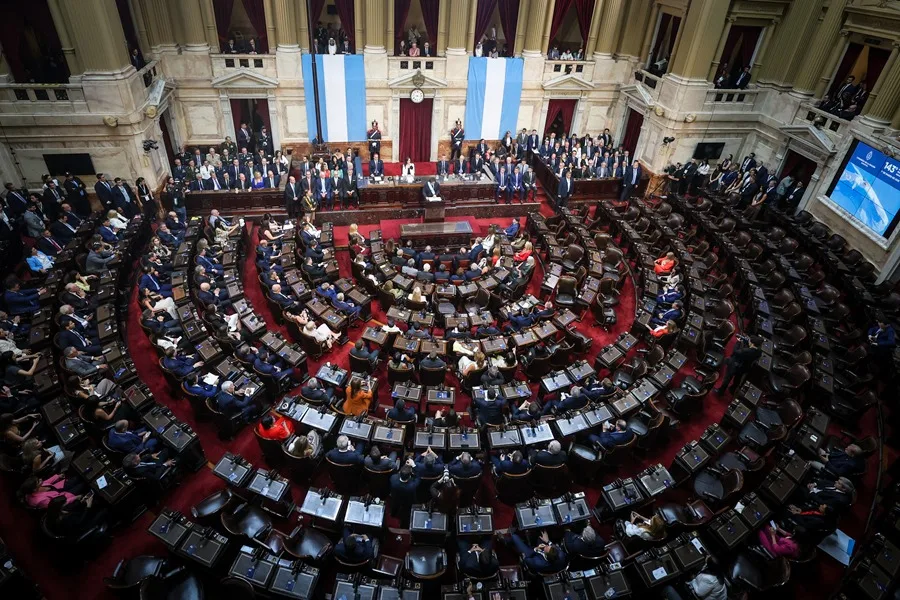
On March 1, a new ordinary legislative period of the Congreso de la Nación Argentina will be inaugurated. As every year, the President will attend the chamber to deliver a message before the Legislative Assembly and outline the main policy priorities planned for 2026.
The opening of sessions represents the key institutional milestone in the relationship between the Executive and Legislative branches. It is the moment of greatest visibility for dialogue—or tension—between the Casa Rosada and Congress, both politically and symbolically. This time, moreover, the context is particularly significant. Following the extraordinary sessions period, during which the Executive concentrated the initiative and set the parliamentary agenda, Congress regains, as of March 1, its full authority to establish its own legislative timelines and priorities.
The presidential address will provide insight into the dynamics shaping this new stage. The key question will be the political tone moving forward—whether the President chooses to consolidate a strategy of confrontation with Congress or opens a more systematic phase of negotiation. On the opposition side, positioning will also be at stake in relation to a ruling coalition that no longer occupies the same place it did two years ago.
The scene also carries its own political and communications component. President Javier Milei introduced the nighttime format for the opening of sessions, seeking to maximize the impact of the message during prime time. He will arrive at the Assembly with an asset he did not have at the beginning of his term: greater legislative weight and part of his agenda already advanced during the summer. This contrast becomes clearer when compared with the scenario he encountered upon taking office in December 2023.
Evolution of the Ruling Coalition’s Strength in Congress
At the start of his administration, La Libertad Avanza stood as the third-largest minority in both chambers of Congress. In the Cámara de Diputados, it held 37 seats—far from the 129 required for quorum—while in the Senado de la Nación it controlled just 8 seats. Unión por la Patria consolidated itself as the largest minority and, in the Senate, was only two senators short of the number needed to open a session.
Without its own governors and with limited legislative representation, the ruling coalition had to negotiate bill by bill in a highly fragmented environment. Building majorities depended on the internal reorganization of the former Juntos por el Cambio and on the willingness of provincial forces to support key initiatives. Parliamentary arithmetic imposed clear limits: any package of structural reforms required broad agreements and a capacity for political coordination that was still being consolidated.
The October 2025 legislative elections substantially reshaped this landscape. In the Chamber of Deputies, La Libertad Avanza increased its representation from 37 to 95 seats. Although it still lacks its own majority, it now stands 34 seats short of quorum, and its relative position is considerably stronger than in 2023. In the Senate, the ruling bloc grew from 8 to 21 members, sharing first place with the Justicialist bloc, which also holds 21 senators. No single force reaches the 37-seat quorum on its own, consolidating the pivotal role of provincial blocs and mid-sized parties.
The central difference between 2023 and 2026 is not only quantitative but institutional. The ruling coalition moved from being a third minority with limited influence to becoming one of the central blocs in both chambers, with greater veto power and broader room for negotiation. Parliamentary dynamics are no longer defined by legislative survival but by the capacity to structure either ad hoc or stable majorities depending on each bill.
This relative strengthening does not eliminate Congress’s fragmented logic. No force holds its own majority in either chamber. In the Chamber of Deputies, the ruling coalition still depends on agreements with mid-sized blocs to reach quorum. In the Senate, territorial dynamics and the weight of governors will remain decisive. The role of provincial forces and intermediate blocs has consolidated as a structural feature of the current political system.
In this context, the March 1 opening of sessions will not merely present the Executive’s 2026 agenda but will serve as the first public signal of the type of relationship that may be built in this new stage. The challenge lies not only in the substance of the announced initiatives—such as potential criminal, electoral, or tax reforms—but in the architecture of agreements required to make them viable.
The Congress that will receive the presidential address is different from that of December 2023: more balanced, less asymmetric, and with renewed incentives for negotiation. The question opening this new ordinary period is not whether tensions will arise—an inherent feature of a system without automatic majorities—but under what modality they will be managed: confrontation, tactical cooperation, or the construction of more stable coalitions.